
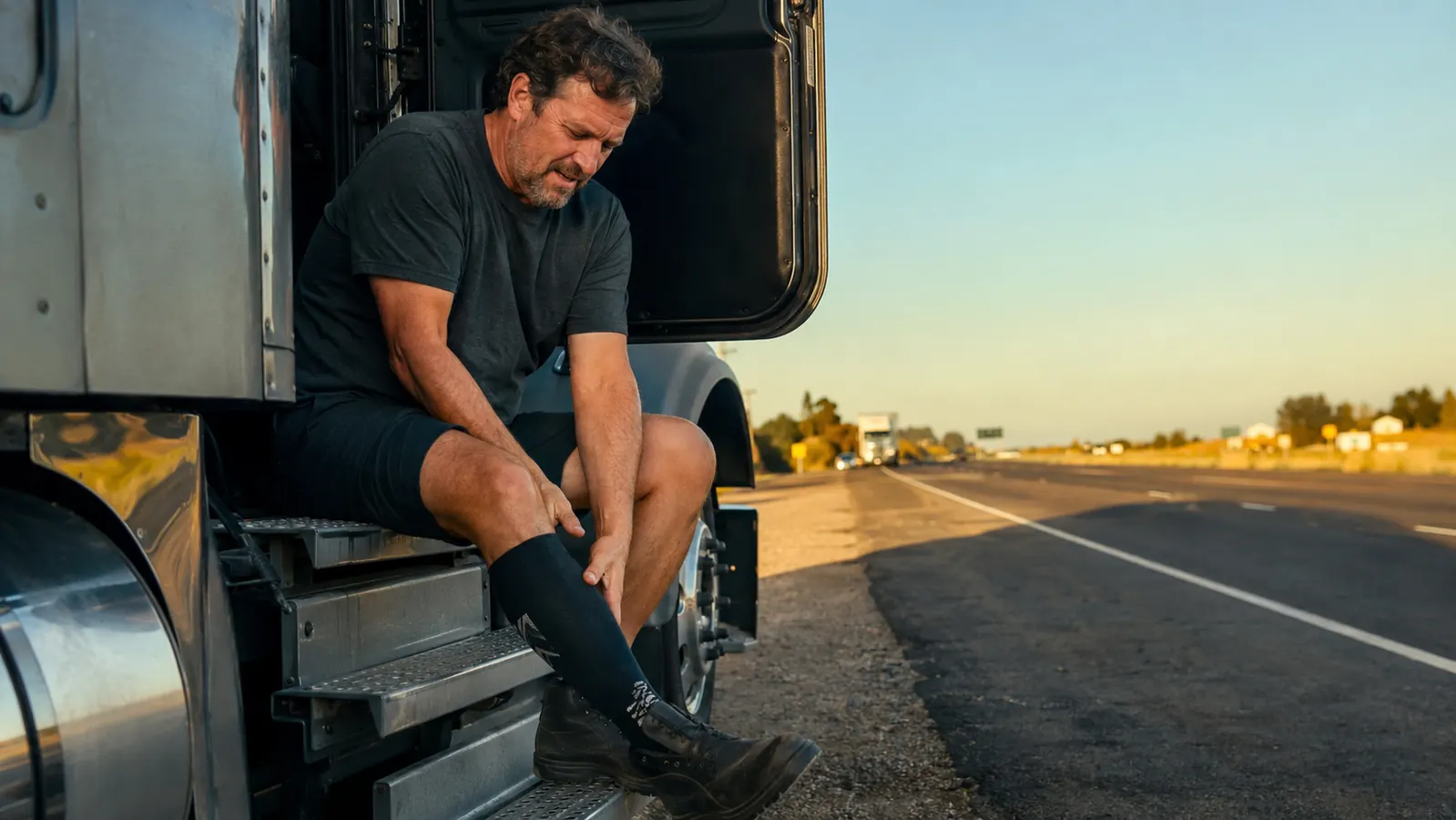
I have been driving long-haul for eleven years. I run the I-40 corridor mostly, sometimes dipping south on I-10, occasionally up to Chicago on I-65. On a standard week I put in somewhere between 3,000 and 3,500 miles. And for most of those years, by the time I pulled into a yard or a rest stop for the night, my ankles looked like someone had stuffed tennis balls under the skin. I thought that was just part of the job. Then I started using CHARMKING compression socks and paying attention to a few other things, and the swelling dropped significantly within the first two weeks. This guide covers everything I now do, in the order I do it, so you can actually follow it on the road.
Leg swelling on long hauls is not just cosmetic. When you sit for hours with your knees bent and your feet on the pedals, blood pools in the veins of your lower legs. The longer you sit, the more fluid leaks out of the capillaries into the surrounding tissue. That is edema. It makes your legs feel heavy, makes your boots tight, and over years of daily repetition it puts real strain on your vascular system. The good news is that it is preventable, or at least manageable, with a few consistent habits. None of them are complicated. All of them require actually doing them every single day, not just when your ankles are already ballooned.
Your legs are in that seat 10 hours a day. Give them some help.
CHARMKING compression socks deliver 15-20 mmHg of graduated compression, which is the range most circulatory health guidelines recommend for prolonged sitting. Over 89,000 Amazon reviews back them up. I wear a pair on every run.
Amazon Check Today's Price on Amazon →Step 1: Put Your Compression Socks on Before You Start Moving
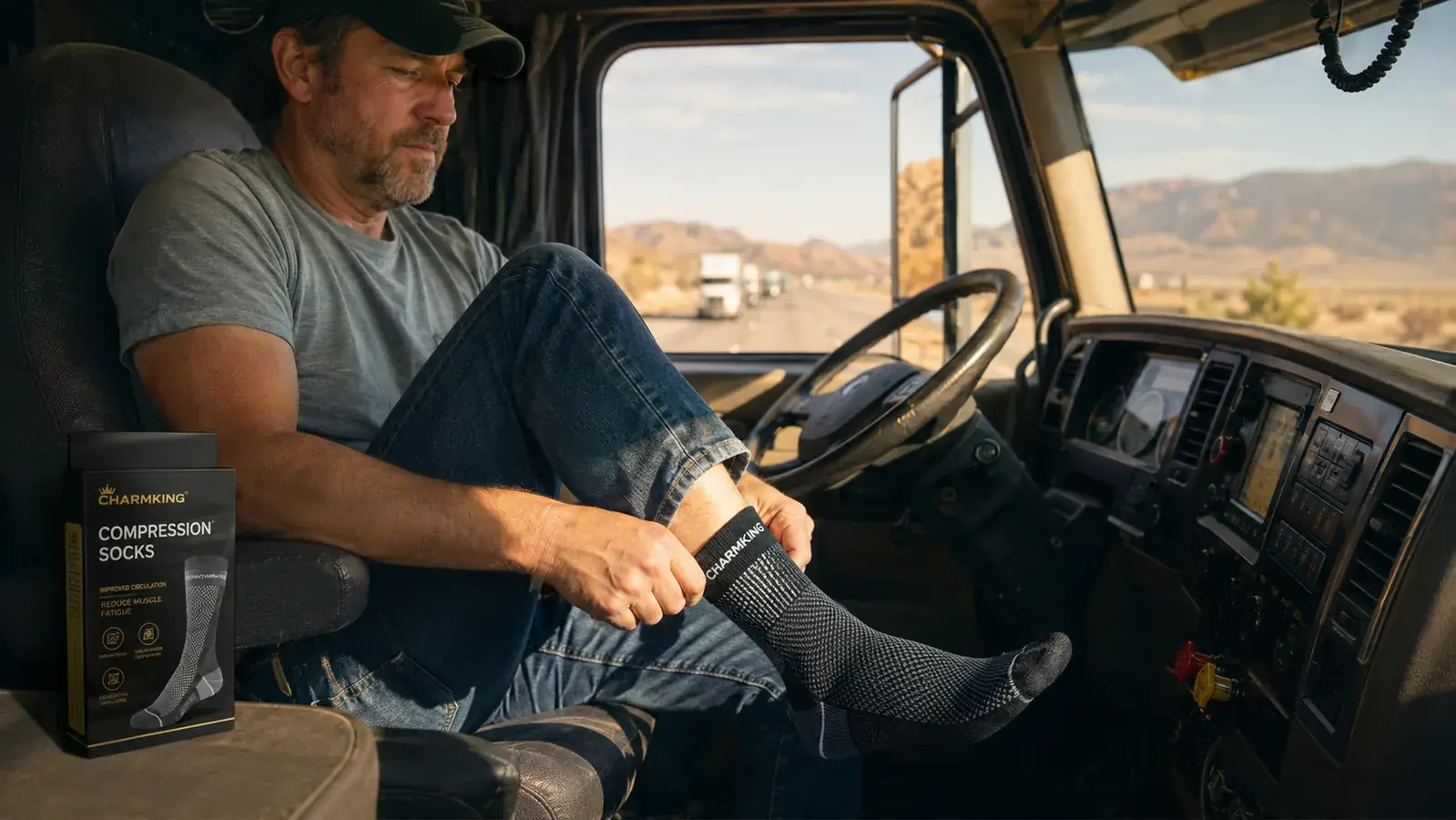
This is the step most people skip or do wrong. I used to pull my compression socks on at a rest stop around hour four, when my legs were already starting to feel heavy. That is backwards. Compression works by preventing fluid from pooling in the first place, not by pushing it back out once it has already settled in. The socks need to go on before you sit down for that first stretch, ideally right after you wake up, before your feet even hit the floor. Once you are vertical and moving around, blood has already started shifting to your lower extremities. Put them on while you are still horizontal or just swinging your legs off the bunk.
For the compression to work, fit matters. I wear a size large in most socks and that is where I land in the CHARMKING sizing chart based on shoe size and calf circumference. If the sock is bunching around your ankle or cutting into your calf at the top band, you have the wrong size. A properly fitted graduated compression sock should feel snug at the ankle and noticeably lighter pressure as it moves up the calf. That gradient is the whole mechanism. Too loose and it is just a regular sock. Too tight at the top and you have created a tourniquet effect, which makes the problem worse.
I keep three pairs of CHARMKING socks in rotation, which is exactly the three-pair set they sell. One pair on, one in the bag, one drying or in the laundry at the yard. That way I am never tempted to skip a day because my clean pair is buried somewhere. The fabric holds up well through machine washing, though I hang them to dry rather than throw them in the dryer. Heat degrades the elastic fibers over time. After about four months of daily use on my current set, the compression still feels consistent when I put them on in the morning.
Step 2: Manage Your Hydration in a Specific Way
The counterintuitive truth about leg swelling is that dehydration makes it worse, not better. When your body is low on fluid, it holds onto what it has, and some of that retained fluid ends up in your tissue rather than staying in your bloodstream where it belongs. Most truckers I know drink less water than they should because bathroom stops eat into drive time. I get that. But the fix is not to drink less. It is to drink steadily throughout the day in moderate amounts so you are not forcing a bathroom stop every ninety minutes, rather than chugging a bottle all at once.
What I actually do: I fill a 40-ounce insulated bottle at the start of the day. I aim to finish it by early afternoon, then refill at a fuel stop. That spread keeps me adequately hydrated without creating urgency at bad times. I have cut out most of the gas station energy drinks I used to rely on. Caffeine is a mild diuretic, and I was essentially undoing my hydration every time I cracked a can. I kept one coffee in the morning for the wake-up and replaced the afternoon energy drink with water plus a small snack. My ankles responded to that change faster than almost anything else.
Sodium matters too. Truck stop food is high in sodium, and excess sodium causes your body to retain water. I am not going to tell you to eat salads at every stop because that is not realistic on the road. But being aware of it helps. On high-sodium days, I drink more water than usual and I am more disciplined about my movement breaks, which gets us to step three.
Step 3: Take Movement Breaks on a Hard Schedule
The federal hours-of-service rules already mandate a 30-minute break after eight hours of driving. That is a legal floor, not a recommendation for circulation health. The vascular system starts getting stressed by prolonged static sitting well before that. What I do is set a timer on my phone for 90 minutes. Every time it goes off, I take five minutes of movement at the next safe opportunity. That might be at a fuel stop, a rest area, or a wide shoulder where I can legally pull over. Five minutes is all I need. I walk the length of the truck a few times, do some calf raises on the bumper step, and flex my feet up and down while I am standing.
Those calf raises are the key movement. Your calf muscles are often called the second heart because when they contract, they squeeze the veins in your lower legs and push blood back up toward your heart. If you are sitting still all day, that pump is not working. Even two minutes of calf raises at a fuel stop activates it. I do about 20 raises per stop, which takes about 90 seconds. Nobody looks at you funny. You look like you are stretching, which is exactly what you are doing.
The calf muscles are the second heart. Every time they contract, they pump blood back up out of your lower legs. Sitting still all day means that pump goes quiet.
Step 4: Adjust Your Seat Position to Help Circulation
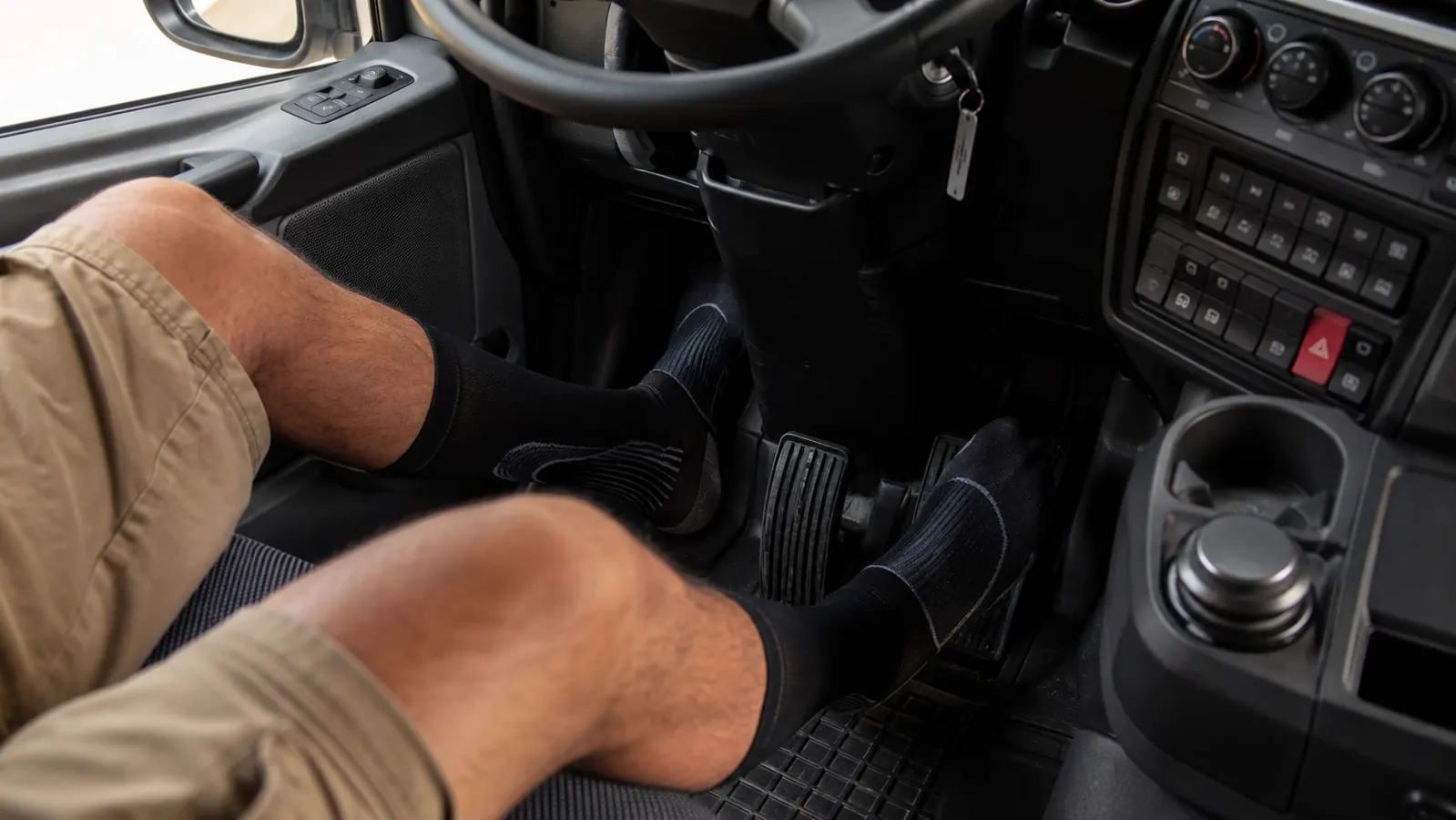
Most truckers run their seat in whatever position felt comfortable the day they set it up and never change it. I did the same thing for years. The problem is that a seat position optimized purely for reach can put a hard edge of the seat pan against the back of your thighs, which compresses the femoral veins that return blood from the legs. Over eight hours, that pressure adds up. The fix is to make sure there is at least two fingers of clearance between the back of your knee and the front edge of the seat cushion. If the seat is too far forward, the edge digs in. Slide it back slightly so your knee is not pressed directly against that front edge.
Seat height matters too. You want your hips roughly level with or slightly higher than your knees when your foot is on a pedal. If your hips are lower than your knees, blood has to work harder to get back up. Most air-ride truck seats have height adjustment, and I spent about ten minutes one afternoon experimenting with mine until I found a position where my legs felt less compressed after a full shift. That ten minutes paid off. Also, whenever I am at a fuel stop or rest area sitting in the cab but not driving, I prop my feet up on the dash or the lower part of the steering column. Elevating the legs for even a few minutes helps drain the fluid that has built up.
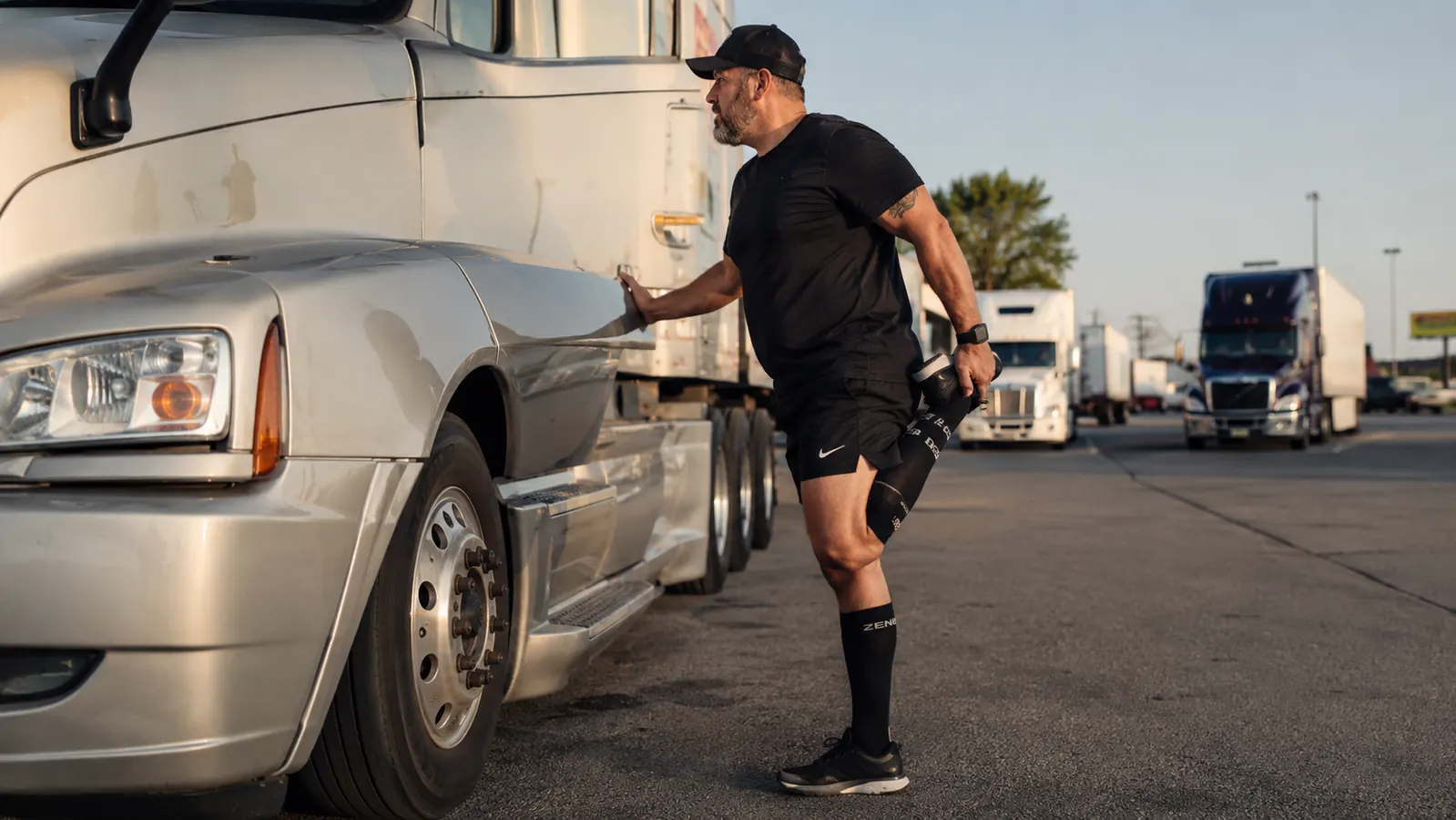
Step 5: Build an End-of-Day Recovery Routine That Takes Less Than 10 Minutes
At the end of a long day, your legs have been fighting gravity for 10 or 11 hours. Most of what you do at that point is about recovery, not prevention. The simplest and most effective thing is elevation. When I get into the bunk at night, I put my jacket under the foot end of the mattress to create a slight incline. Two or three inches of elevation is enough for gravity to help move residual fluid back toward the core while you sleep. I have been doing this for about eight months and it makes a noticeable difference in how my legs feel the next morning.
Before bed I also take the compression socks off and do a simple self-massage on both calves. Nothing complicated. I just use both hands to squeeze and stroke the muscle from the ankle up toward the knee, about ten strokes per leg. It takes maybe three minutes. Then I keep my legs elevated. In the morning the socks go back on before I get up, and the cycle starts again. This routine is not glamorous but it is consistent, and consistency is the only thing that actually works for chronic edema from long-haul sitting.
One more thing worth saying: if your swelling is severe, affects only one leg, comes with pain, redness, or warmth, or does not respond to these habits after a couple of weeks, see a doctor. Deep vein thrombosis is a real risk in the trucking population and it presents with swelling. Everything in this guide is for normal, bilateral edema from prolonged sitting. It is not a substitute for a medical evaluation if something feels wrong.
What Else Helps
Beyond the five steps above, a few smaller habits are worth adding to the mix. Anti-inflammatory foods make a measurable difference if you can manage it on the road. Bananas and potassium-rich foods help regulate fluid balance. Avoiding long stretches of air conditioning with your feet aimed directly at a vent can help, as cold air can cause vasoconstriction in the extremities. Some drivers swear by magnesium supplements for reducing overnight cramp frequency, which often accompanies chronic leg swelling. I take magnesium glycinate before bed and find it helps with the restless, tight feeling in my calves that used to keep me up.
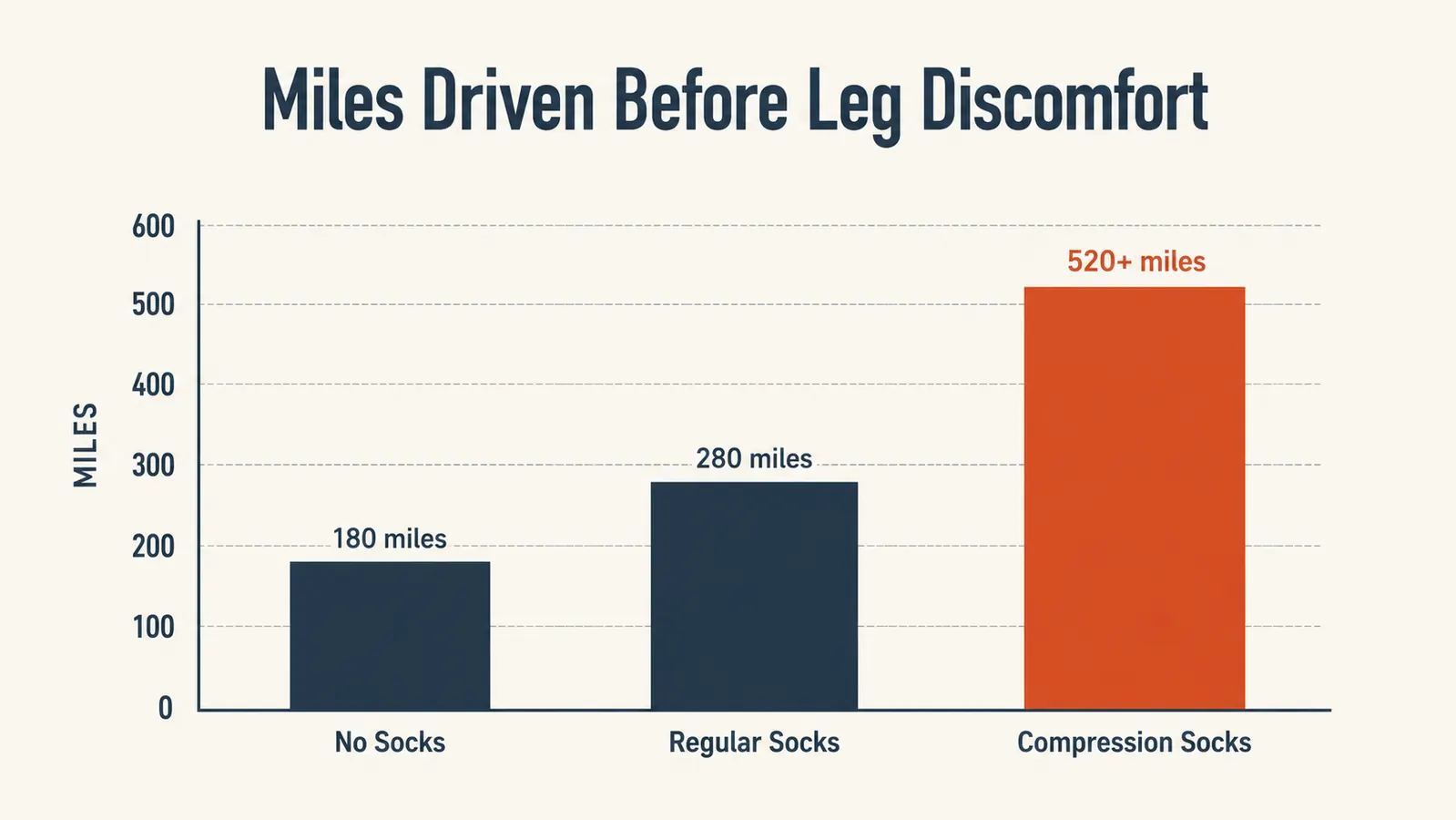
The CHARMKING socks are the piece of this puzzle I would not give up. They work because the compression is graduated: tighter at the ankle and loosening as it goes up the calf, which actively assists venous return rather than just squeezing the whole leg equally. At their price point, you can pick up the three-pair set and rotate them indefinitely without worrying about babying them. They wash well, they do not bunch in the cab boot, and the seam at the toe is flat enough to not cause a pressure point over a full day of wear. For the internal links in my related articles, I break down the comparison of compression versus regular socks in more detail at the full CHARMKING review, and if you want the quick-reference version, I listed the top reasons compression socks help in the 10 reasons guide.
If your legs are swollen at the end of every run, the socks are the easiest fix to add today.
CHARMKING compression socks come in a three-pair set at 15-20 mmHg. That is the graduated compression range that actually moves fluid. They fit in any boot, wash clean, and hold their compression after months of daily use. Start with the sizing guide before you order -- fit is everything with compression.
Amazon Check Today's Price on Amazon →