
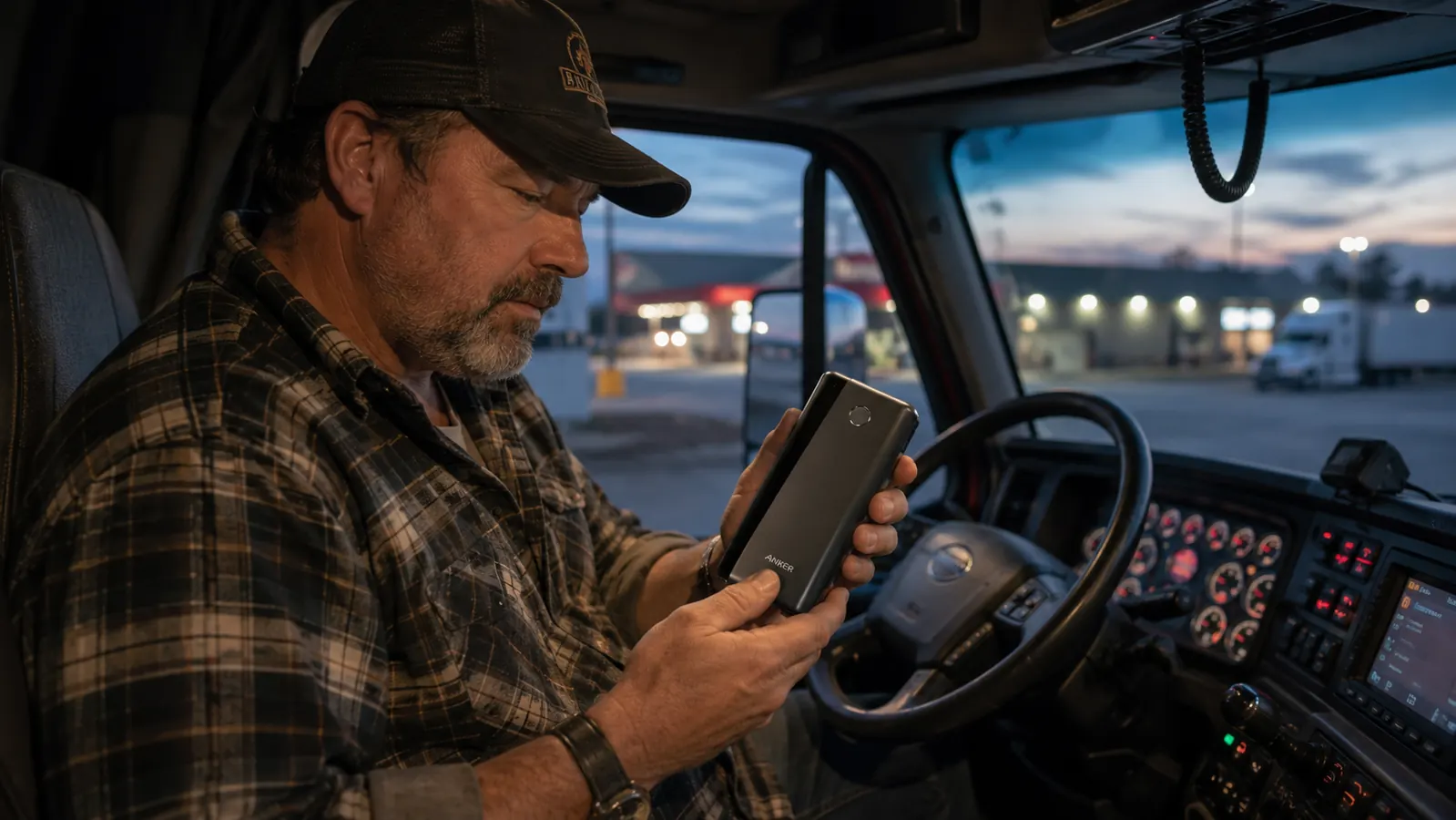
I run the I-40 corridor out of Memphis, and the Anker Zolo 20,000mAh has been riding in my center console since last December. Six months. Somewhere north of 120 charge cycles. My phone, my ELD tablet, and a backup GPS all depend on it when I do not want to run the inverter and drain my truck batteries at a rest stop.
Before this one I went through two cheaper power banks in about eight months total. One swelled up after a summer in the cab. The other just stopped holding a charge after maybe sixty cycles. I wanted something built to survive heat, vibration, and constant use. Six months in, here is my honest account of what the Zolo actually delivers.
The Quick Verdict
A genuinely high-capacity power bank that holds its output across hundreds of cycles, with a built-in cable that has stayed intact through daily cab use. Knocked back one point for the slow self-recharge time and the chunkier size.
Amazon Check Today's Price →If dead devices are costing you miles, this is the fix.
The Anker Zolo 20,000mAh has 4.5 stars across more than 25,000 reviews. It charges a full-size phone six to seven times on a single fill. Check today's price and see if it ships in time for your next run.
Amazon Check Today's Price on Amazon →How I've Used It Over Six Months
My standard run is Memphis to Los Angeles, about 1,850 miles. I leave home with the Zolo fully charged and the truck plugged in at the terminal. Once I am rolling, the cab only gets power from a 12V outlet, so anything that needs more than a trickle charge depends on the power bank or an inverter. For overnight stops at rest areas where I do not want engine noise, the Zolo handles everything.
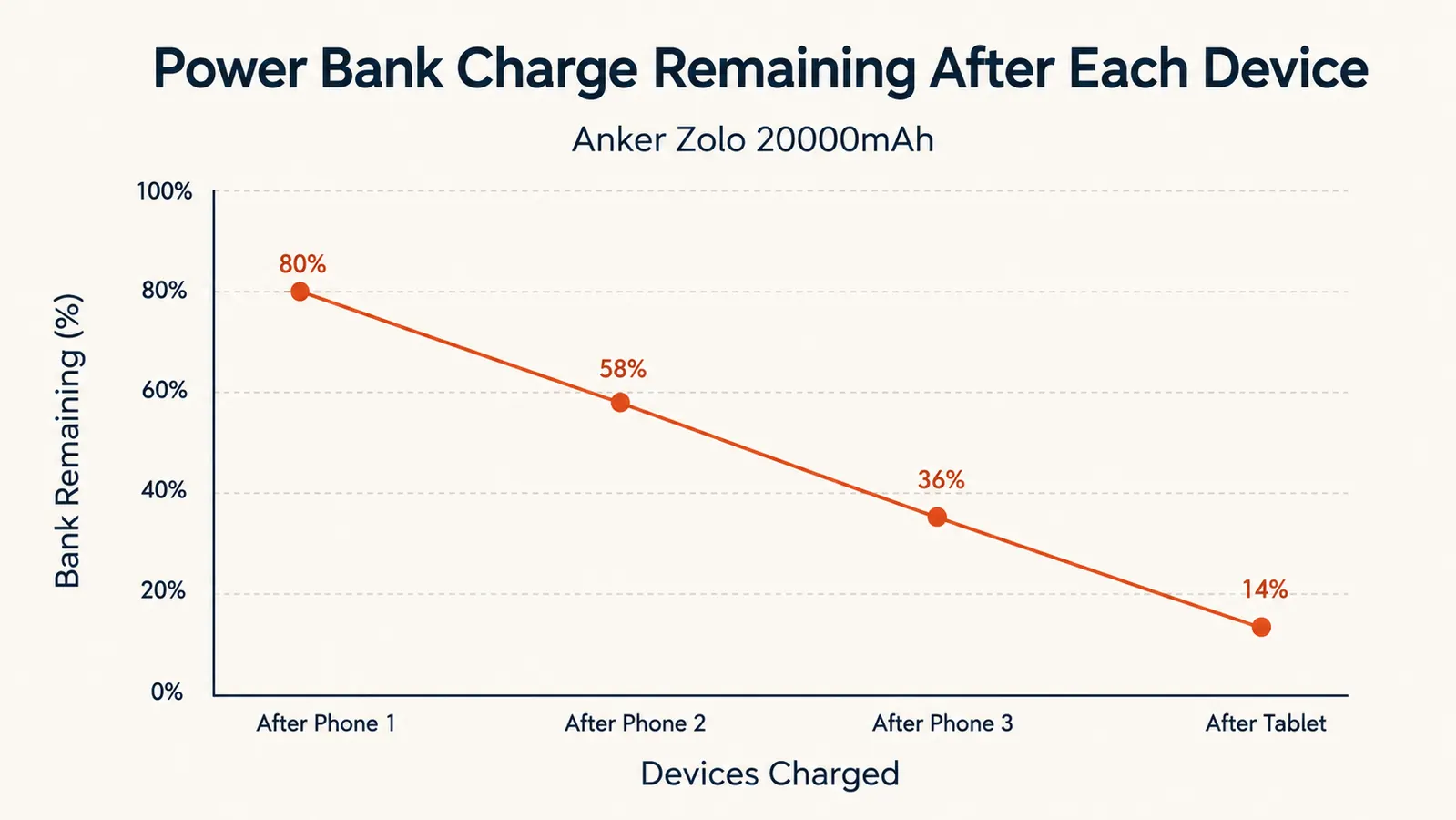
A typical day on the road: phone navigation runs all day through a mount on the dash, which drains about 40 percent of my Galaxy S23 battery over a 10-hour drive. I top it off from the Zolo twice during the day, then charge my ELD tablet before I log off at night. That is roughly 1.5 full phone equivalents per day from the power bank. Over a three-day run, I am putting about 4.5 phone-equivalents of draw through the Zolo before I can plug it into a wall or a proper inverter at a shipper.
The Zolo handles that pattern without complaint. I average about 20 charge cycles per month, which puts me around 120 cycles over the review period. Real-world capacity has not noticeably dropped from where it was in month one.

Real-World Capacity: What 20,000mAh Gets You in a Cab
The spec says 20,000mAh. Real-world output is always lower because of conversion losses between the lithium cells and the USB output. Anker's efficiency on this unit runs roughly 85 to 88 percent, which is solid for a power bank in this price range. That translates to about 17,000mAh of usable output.
My Galaxy S23 has a 3,900mAh battery. A full charge from empty to 100 percent draws about 4,500mAh from the power bank after losses. That means the Zolo gives me roughly 3.7 full charges of my phone per fill. If the phone starts each charge at 40 percent, I am getting closer to 6 to 7 top-offs per cycle, which lines up with what Anker advertises.
For the ELD tablet, a 7,000mAh device, I get about two full charges. That covers a two-day run without hunting for an outlet. The 30W output through the USB-C port handles the tablet fast, about 90 minutes from dead to full, which matters when I am on a 30-minute rest break and need it ready before I roll again.
I have not seen meaningful capacity fade in six months. I track this informally by counting how many topping charges I get per fill before the LED indicator drops from four dots to three. That number has stayed consistent. Whatever chemistry Anker is using in the Zolo's cells is holding up better than either of the budget power banks I used before.
The Built-In Cable After 120 Cycles
This was the feature that made me pick the Zolo over a plain brick. Built-in cables on cheap power banks are the first thing to fail. The wire gets kinked at the connector, the insulation cracks, and you end up with a power bank that requires a separate cable anyway. I wanted to see if Anker's implementation was any different.
After six months of daily use, the built-in USB-C cable is still intact. The connector seats cleanly, there is no fraying at the exit point from the housing, and the cable does not wobble when plugged in. I have pulled it out and tucked it back in at least 120 times by my count. It wraps cleanly into the built-in channel without fighting you.
One thing to know: the built-in cable is USB-C only. My older ELD unit uses a USB-A to Micro-USB connection, so I still carry a separate cable for that device. If all your gear is USB-C, the built-in handles everything. If you have mixed devices, plan for one extra cable in your bag.
After 120 pull-and-tuck cycles, the built-in cable still seats clean and shows no fraying. That alone separates this from every budget power bank I tried before it.
Charging Speed: 30W Output, But How Fast Does It Refill?
The 30W USB-C output is genuinely fast for a power bank. My S23 goes from 20 percent to 80 percent in about 45 minutes on the Zolo, which is close to what I get plugging directly into a wall adapter. The USB-A port drops to 12W, which is slower but fine for topping off overnight while I sleep in the bunk.
The weak point in the speed story is how long the Zolo takes to recharge itself. Filling the 20,000mAh from empty to full takes about 4 to 5 hours on a 30W wall charger. At a shipper where I have 3 hours in the dock, I can get it from 20 percent to about 70 percent, which is workable. But if you left it fully dead and are counting on a 2-hour window, you will leave with a partial charge. This is not unique to the Zolo, since big-capacity batteries just take time. It is worth factoring in when you plan your stops.
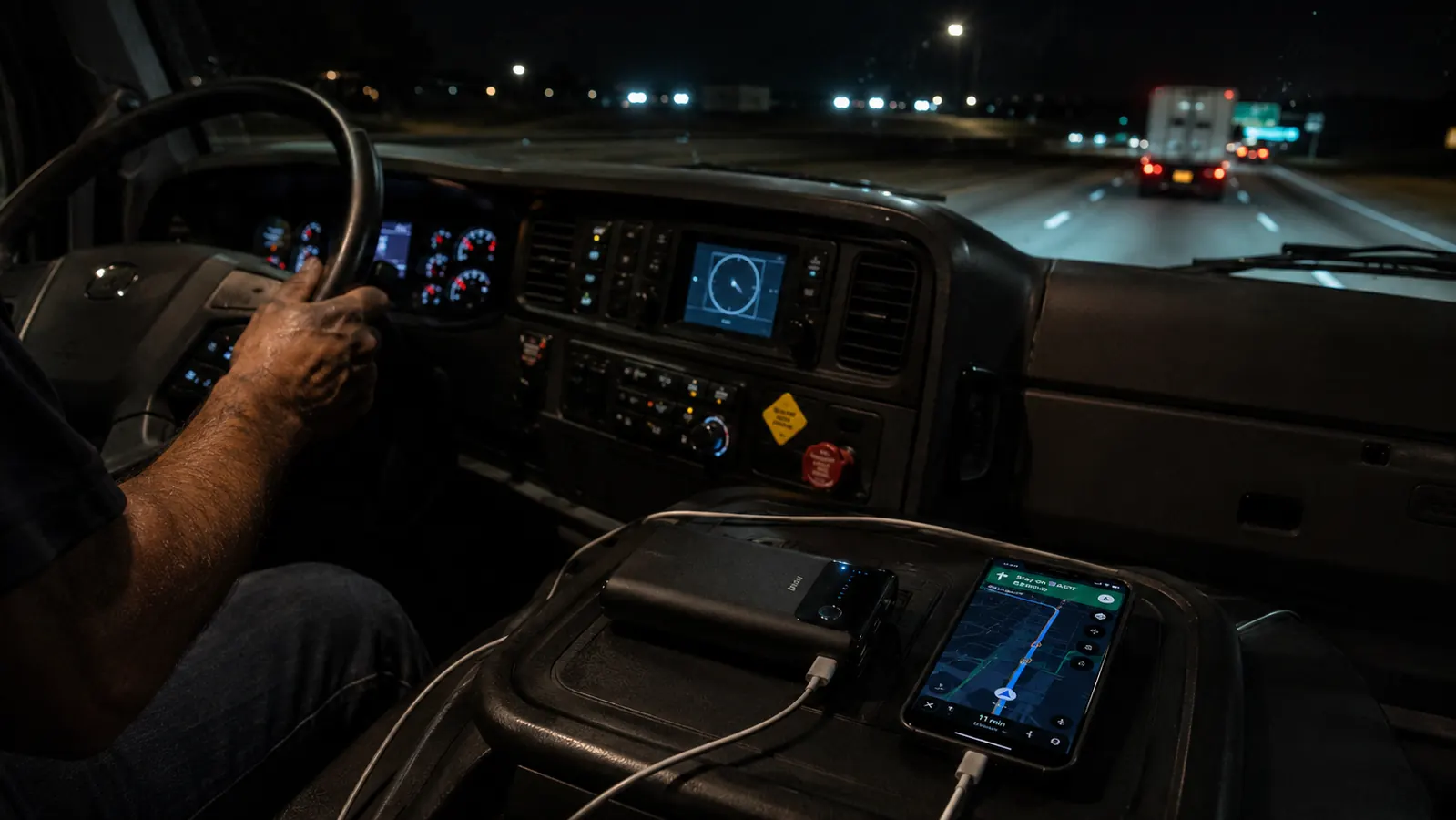
I have tried plugging it into my truck's USB-C port while rolling. That delivers about 18W in my rig, so the Zolo charges but slowly. Over an 8-hour driving day starting from 30 percent, I can usually get it to around 75 percent through the cab outlet. Not ideal, but enough to keep the buffer topped up on a long run.
Heat, Vibration, and Living in a Cab
This is the test most reviews skip because they write from a desk. A truck cab in August in Texas hits 130 degrees Fahrenheit inside when parked in direct sun. I left the Zolo in the center console through a full summer. It gets warm during charging, as all lithium packs do, but I have not had it refuse to charge or throw any thermal protection cutoff in normal cab temperatures while driving. I do not leave it sitting in direct sunlight in the summer if I can help it, which is basic lithium battery hygiene.
The housing is a matte rubberized plastic that does not show scratches from rattling around with coins and pens in the center console. The four LED indicator dots on the front are easy to read in full sun or at night without turning on the cab light. Size is a legitimate consideration: this is a larger unit, roughly the size of a thick paperback book. It does not slip into a jeans pocket. It fits in a door pocket, a center console, or a backpack side pocket. If you need something pocketable, this is not it.
Comparing Charge Cycle Performance Month by Month
I tracked usage informally by noting how many times per month I fully depleted the Zolo and recharged it. The numbers have been steady: 18 cycles in December when I started, climbing to 22 in January during a busy run schedule, then settling into the 19 to 21 range for the rest of the period. No spike in charge times. No change in how many phone charges I pull per fill. Lithium cells typically start showing capacity degradation after 300 to 500 full cycles. At 120 cycles in, the Zolo is in the early part of that curve, and it shows.
For comparison, the last budget power bank I tried showed noticeably shorter battery life by month three, around 60 cycles, and I had to retire it at month four when it would not hold more than half a charge. The Zolo is outpacing that by a wide margin.
What We Liked
- 20,000mAh capacity delivers consistent 3 to 4 full phone charges per fill, even after 120 or more cycles
- Built-in USB-C cable held up without fraying or loosening over six months of daily pull-and-tuck use
- 30W output charges a modern smartphone to 80 percent in under an hour
- Rubberized matte housing resists scratches and handles cab heat without deforming
- Four LED dots read clearly in full sun and complete darkness
- 25,000-plus Amazon reviews with a 4.5-star average signal a proven track record, not a new-to-market gamble
Where It Falls Short
- Self-recharge takes 4 to 5 hours from empty, meaning a 2-hour dock window will leave it partially charged
- Built-in cable is USB-C only, so older Micro-USB devices still need a separate cord
- Physical size is large and does not fit in a pocket; takes real estate in the console or bag
- USB-A port is limited to 12W, which is slow for larger tablets
- No wireless charging output, so you cannot use it as a pad for Qi-enabled devices
Who This Is For
The Anker Zolo 20,000mAh is built for people who spend multiple days away from reliable wall power. Long-haul drivers, weekend overlanders, anyone doing overnight runs on the road. If you are charging one device on a day trip or a quick flight, a 10,000mAh unit is lighter and cheaper. But if you are managing a phone plus a tablet plus the occasional backup device over two or three days, the 20,000mAh capacity means you are not rationing charge or hunting for outlets at every stop. The built-in cable is genuinely useful, one less cord to track down when your phone is at 3 percent and you are half-asleep at a rest area.
It pairs well with a good 30W wall charger so you can max out recharge speed when you do find an outlet. Anker sells a compact 30W GaN cube that fits in the same bag pocket. Fill the Zolo during a 4-hour dock window at a shipper and you leave with enough capacity to cover the return run.
Who Should Skip It
If you want something you can carry in a pants pocket, look elsewhere. This unit is substantial. Travelers who only charge one device and who plug in nightly do not need 20,000mAh. A 10,000mAh option weighs half as much and fits in a shirt pocket. If you run devices with Micro-USB or Lightning connections and you do not want to carry extra cables, the USB-C-only built-in cable creates friction. And if speed of self-recharge is critical because your window between runs is under two hours, the 4-hour fill time is a real limitation.
Also worth saying: if your cab has a working inverter or a solid 12V setup, a power bank is a backup, not a primary. The Zolo earns its place when the inverter is not an option, which for me is every rest-area overnight stop where I do not want engine on or a generator running.
Six months in, it is still the first thing I grab when I leave the terminal.
The Anker Zolo 20,000mAh has held its capacity, its cable, and its output through more than 120 charge cycles in a working truck cab. Check today's price on Amazon and see if it fits your run.
Amazon Check Today's Price on Amazon →