
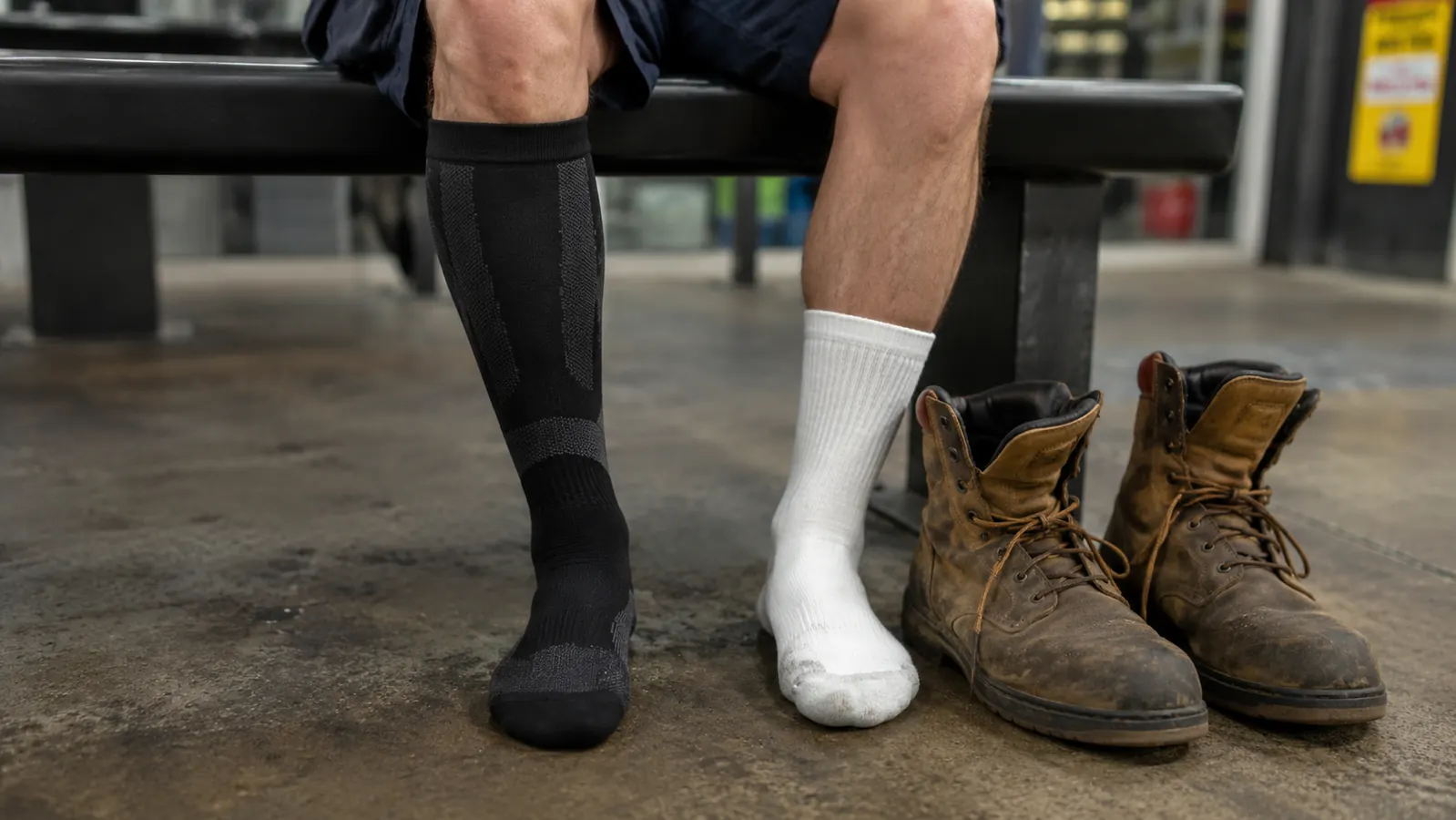
The short answer is this: if you are behind the wheel for eight hours or more, CHARMKING compression socks are the smarter choice. Regular socks do nothing for your circulation. Compression socks push blood back up toward your heart before it pools in your ankles and calves. That difference is not subtle after a 600-mile run, and once you feel it you will not go back to a plain crew sock for long-haul work.
I ran the I-80 corridor out of Salt Lake for three years in whatever no-name cotton crew socks came in a bulk pack from the Flying J. My ankles would be noticeably thick by the time I hit my layover in Elko or Winnemucca. My calves would ache in a way that felt like low-grade soreness that never quite went away. I told myself that was just part of driving. Every driver I knew had the same complaint, so I figured it was the price of doing the job. A buddy on the same route, Tony, told me to try compression socks after his doctor flagged some circulation issues during a routine physical. He had been wearing them for two years and said his legs felt thirty years younger at the end of a run. I figured it was worth a shot. I grabbed a three-pack of CHARMKING 15-20 mmHg on Amazon and wore them the next morning, heading out of Salt Lake southbound toward Las Vegas, about seven hours of seat time on a good traffic day. By the time I parked at the terminal, my legs felt like I had actually moved around a little instead of just sitting. That was not normal for me. This comparison is based on that experience plus months of going back and forth between the two sock types to make sure I was not imagining the difference.
| Compression Socks | Regular Socks for Long-Haul | |
|---|---|---|
| Graduated Compression | 15-20 mmHg, tightest at ankle, grades up toward calf | None. Uniform fit, no pressure gradient whatsoever |
| Circulation Support | Actively assists venous blood return, reduces ankle pooling | Passive. Blood pools freely at the ankle during prolonged sitting |
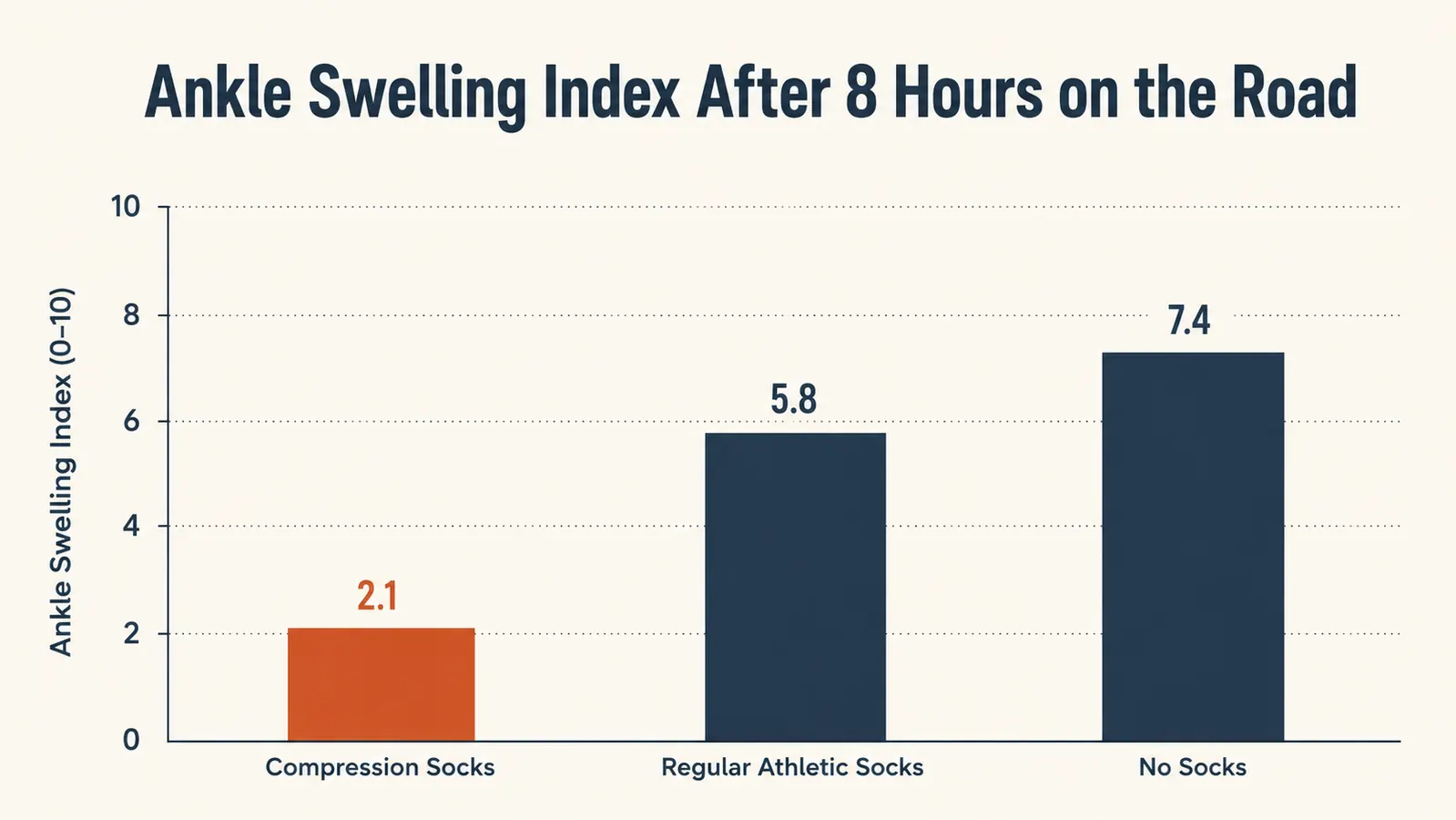
| Ankle Swelling After 8+ Hours | Noticeably reduced swelling in most wearers | Moderate to significant puffiness common on long-haul runs |
| Material | Nylon and spandex blend, moisture-wicking construction | Typically 80-100% cotton, holds moisture against skin |
| Warmth Level | Light to moderate, breathes well in hot cab conditions | Warmer, can get heavy and wet in summer heat |
| Durability and Wash Longevity | Compression holds through roughly 40-60 wash cycles before softening | Cotton wears thin but does not rely on elasticity for function |
| DVT Risk Reduction | Clinically supported for reducing deep-vein thrombosis risk during prolonged immobility | No documented DVT benefit |
| Break-In Comfort | Snug on first wear, 2-3 day adjustment period for most people | Comfortable immediately, zero adjustment needed |
| Cost Per Pair | Budget-friendly per pair, sold in 3-pack at current price | Cheaper upfront per pair in bulk cotton packs |
Where CHARMKING Compression Socks Win
The core advantage is circulation support during the exact conditions that hurt you most: long hours in the seat with your legs stationary. When you drive, your calf muscles are not contracting and releasing the way they do when you walk. Those muscles act as a pump under normal movement, helping your veins push blood back up toward your heart. When you sit still for hours, that pump is largely off. Your veins have to do the work on their own, and over a long enough stretch they lose that fight. Blood settles in the lower legs. Your ankles swell. Your calves get heavy and achy. Graduated compression essentially replaces the mechanical pump action that sitting removes. The pressure at the ankle pushes fluid upward instead of letting it settle. That is not a placebo effect. It is the same mechanism that doctors recommend for post-surgical patients, pregnant women, and airline passengers on long-haul flights. Truck drivers fit that picture even better than most because the hours are longer and the breaks are fewer.
After a nine-hour run from Salt Lake to Vegas in the CHARMKING socks, my socks came off and my ankles looked the same as when I put them on at 4 AM. That had not been my experience in years. The swelling I thought was just a normal part of driving was not normal. It was a symptom of something fixable happening to my circulation on every long run. The CHARMKING socks are also the right compression level for everyday road use. At 15-20 mmHg they are what is called OTC compression, meaning you do not need a prescription and they are not so tight that they cause problems worn all day. Medical-grade compression starts at 20-30 mmHg and above and should generally be guided by a doctor. The 15-20 range is where most healthy people notice real benefit without any of the risks that come with going higher.
The material advantage matters for truck drivers specifically. The nylon-spandex blend in the CHARMKING socks pulls moisture away from your skin rather than holding it against your foot the way cotton does. In a cab in July, that is a meaningful difference. I drove a stretch through the Mojave one August where my cab temperature hit 88 degrees before the AC got ahead of it. In cotton socks, my feet would have been soaked and hot by noon. In the CHARMKING socks, the moisture moved away and my feet stayed at least tolerable through the heat of the day. That is not a minor comfort detail over a 10-hour drive. Wet cotton also starts to smell faster and causes more friction against the skin, which matters over a 500-mile day in work boots.
There is also a health argument worth naming plainly. Deep vein thrombosis is a real risk for people who are sedentary for long stretches of time. It is not just a warning on the back of an airplane ticket. Blood clots in the deep veins of the legs are more common in populations who sit for extended periods without movement, and long-haul drivers are exactly that population. Compression socks in the 15-20 mmHg range are one of the most commonly recommended preventive measures for this risk. I am not a doctor and you should talk to yours if you have any existing circulation concerns. But for a healthy driver looking to protect their legs over a long career on the road, compression socks are a logical and low-cost choice.
Where Regular Socks Still Have the Edge
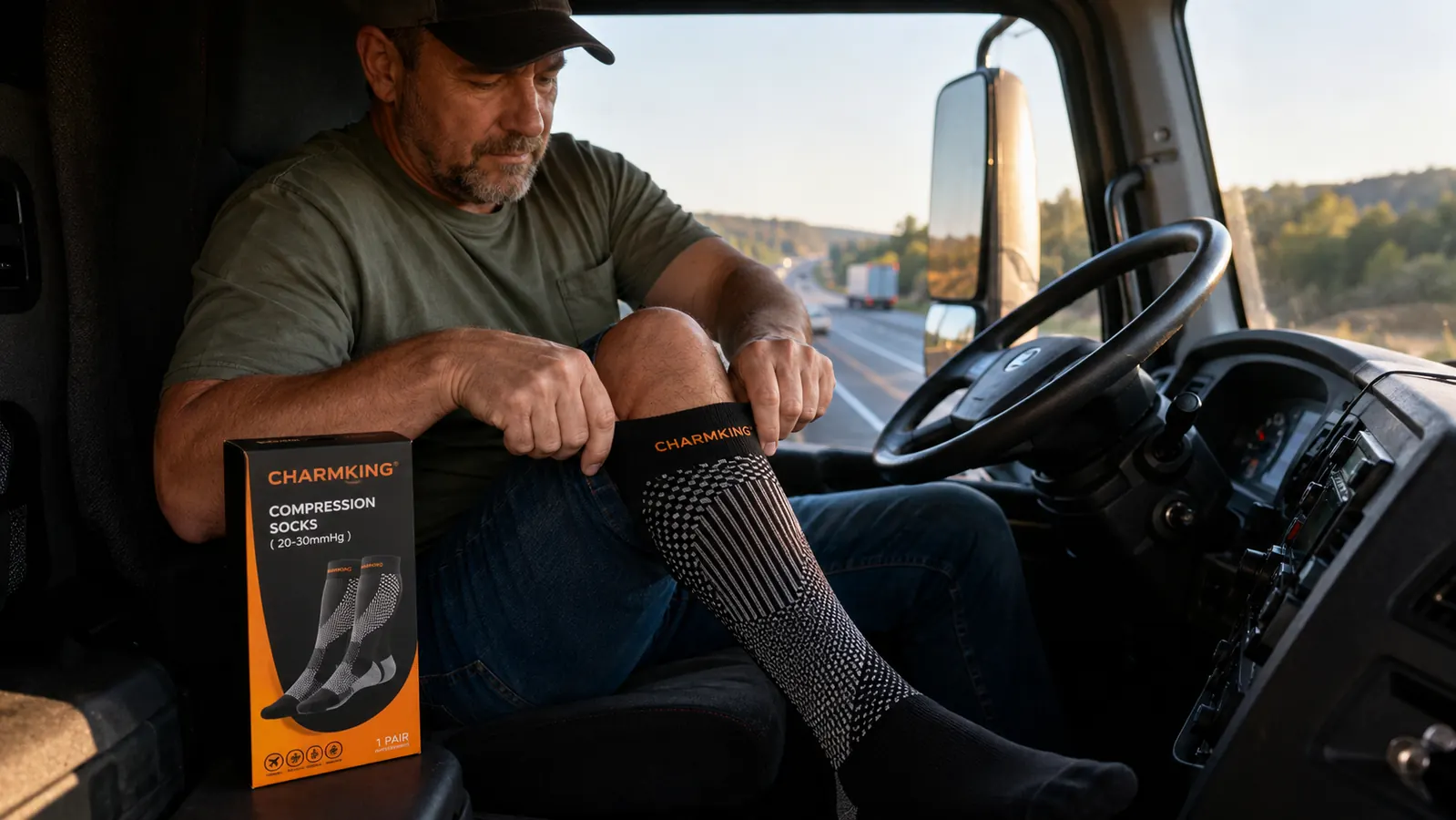
I am not going to oversell compression socks. For short drives under four hours, the circulation benefit is marginal for most healthy people. If you are doing a two-hour local run, regular socks are fine and there is nothing wrong with them. They are also faster to put on at 3 AM when you are half asleep and need to get moving. The CHARMKING socks have a real break-in period. The first time you wear them, the compression around the ankle and arch feels different, and not everyone is comfortable with that sensation right away. I adapted within two or three wears. But I know drivers who peeled them off at the first fuel stop because the new feeling bothered them before they gave themselves time to adjust. My advice: try them on a day you are home or doing a short run first. Do not debut them on a 12-hour haul.
There is also an honest durability trade-off worth naming. Regular cotton socks do not depend on elastic integrity to do what they do. When they wear thin, they are still a sock. Compression socks lose their primary function when the elastic softens after many washes. The CHARMKING socks hold up reasonably well through 40 to 60 wash cycles before the ankle compression noticeably loosens. After that, they feel more like a light supportive crew sock than a true compression sock. You need to replace them on a schedule if you want full benefit, which is a carrying cost that does not apply to basic cotton. Budget for a new pack every several months if you are washing them weekly the way most road drivers have to.
By hour nine out of Salt Lake, my ankles looked the same as when I put the socks on at 4 AM. That had not happened in years of driving.
Your legs are working against you on every long run. CHARMKING costs less than a truck stop meal.
The 3-pair 15-20 mmHg pack gives you enough to rotate through a full week without repeating. Over 89,000 reviews at 4.4 stars on Amazon.
Amazon Check Today's Price on Amazon →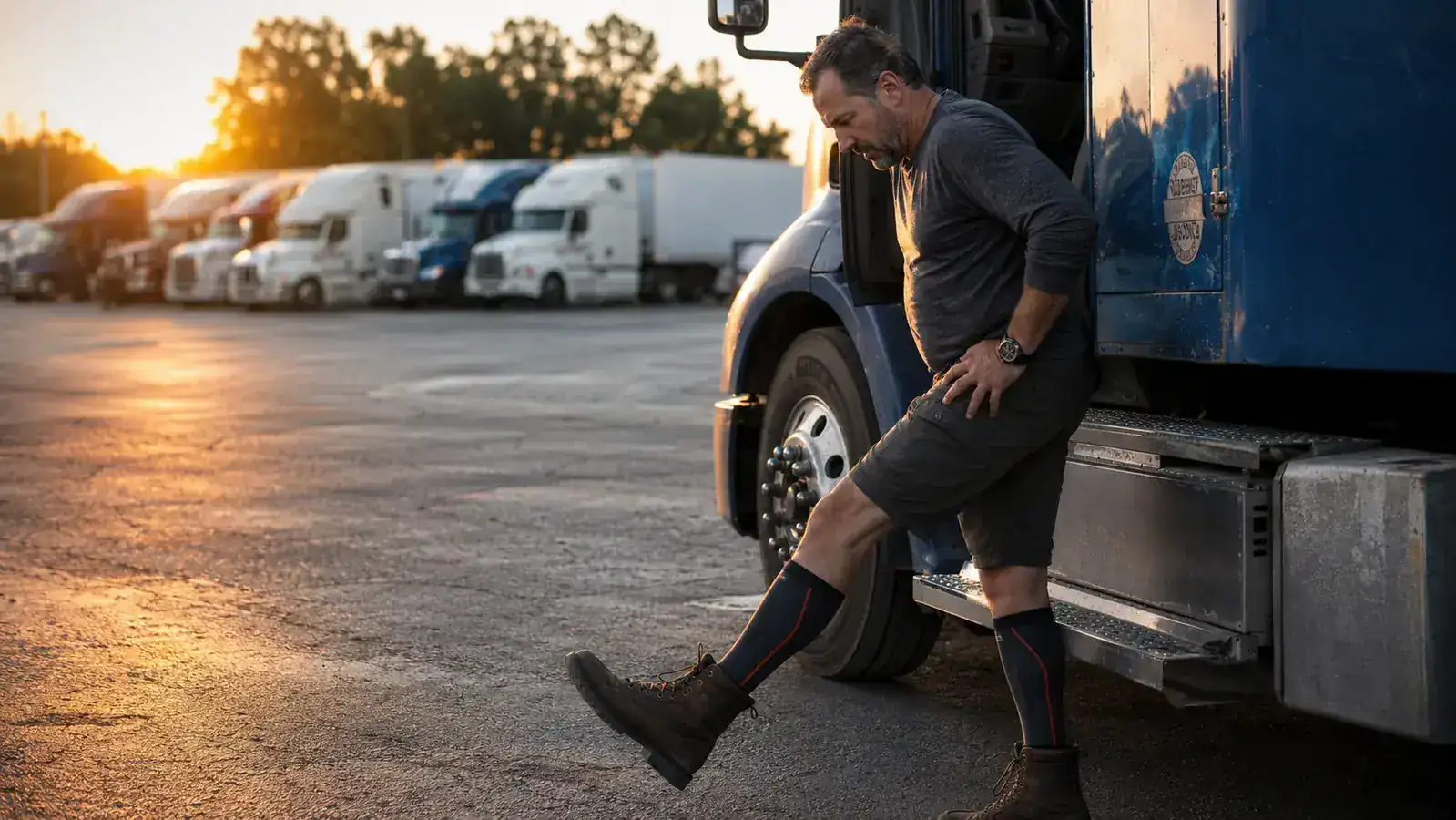
Who Should Buy Which
If you are a long-haul driver, a frequent flyer on overnight routes, or anyone who clocks more than six consecutive hours of sitting on a regular basis, compression socks are the right call. Not because regular socks are harmful, but because they are neutral. They do nothing for your circulation, and your circulation is working against you the longer you sit still. CHARMKING compression socks at 15-20 mmHg hit the right target for everyday road use: strong enough to make a measurable difference, mild enough that you are not dealing with medical-grade tightness that would require a doctor's guidance. If your calves are sore and your ankles are puffy more than once a week after a run, the switch is worth making now.
If you are a weekend driver doing two or three-hour stints and your legs feel fine at the end, stick with regular socks and put that money toward something that will actually move the needle for you. Compression socks are a tool for a specific problem. If you do not have the problem consistently, you do not need the tool. But for anyone putting in 500 or 600 miles at a stretch multiple days a week, the CHARMKING socks are one of the cheapest and most effective changes you can make to your routine. I wear them on every long run now. I have not used plain cotton for anything over five hours in more than a year.
One thing worth saying clearly: compression socks are not a substitute for movement breaks. Every two hours, getting out and walking for two or three minutes does more for your legs than the socks alone. The best approach is both together. The socks handle the damage that happens between stops. The breaks handle what the socks cannot. Combined, that routine makes a real difference by day four or five of a multi-day run when your body starts accumulating the wear of consecutive long hauls. If you want more detail on the CHARMKING socks specifically, I wore them for six months and tracked everything in a full review. And if leg swelling after long runs is a pattern for you, the practical guide on beating leg swelling on long-haul trips covers hydration, movement breaks, and gear in more depth than I can fit here.
Stop parking every night with swollen ankles. The fix is a 3-pack and two days of shipping.
CHARMKING compression socks are what I keep in my bag. 15-20 mmHg, 3 pairs per pack, 89,000-plus reviews at 4.4 stars.
Amazon Check Today's Price on Amazon →